

MMM Dims Migration Guide#
This guide covers the changes introduced by the migration of PyMC-Marketing’s MMM internals to pymc.dims and PyTensor’s xtensor system.
The impact depends on how you use the library:
High-level users (standard model fitting, prediction, budget optimization): minimal changes.
Low-level users (custom transformations, extensions, direct model building): significant API changes.
import warnings

import numpy as np
import pandas as pd

from pymc_marketing.mmm import GeometricAdstock, LogisticSaturation
from pymc_marketing.mmm.mmm import MMM
High-Level Users: Prior Array Parameters#
If you use MMM through its standard API (fit, predict, budget optimization), nothing changes in your workflow.
The one thing you may notice is a new warning when passing raw arrays or lists as prior parameters. Previously, a value like mu=[2, 1] was passed through without any dimension information. Now, the system needs to know which dimension the array corresponds to.
By default, array parameters are assumed to map to the rightmost dimension of the prior’s dims. For instance, when the MMM sets dims=("channel",) on your saturation beta prior internally, a 1D array is assumed to be along "channel". This works, but emits a warning encouraging you to be explicit.
from pymc_extras.prior import Prior

# Per-channel saturation beta: raw list triggers a warning at build_model time
saturation_beta_prior = Prior("Gamma", mu=[2, 1], sigma=1, dims=("channel",))
mmm_with_warning = MMM(
    date_column="date",
    channel_columns=["TV", "Radio"],
    adstock=GeometricAdstock(l_max=8),
    saturation=LogisticSaturation(),
    model_config={"saturation_beta": saturation_beta_prior},
)

# Dummy data to build the model
rng = np.random.default_rng(0)
n = 52
df = pd.DataFrame(
    {
        "date": pd.date_range("2024-01-01", periods=n, freq="W-MON"),
        "TV": rng.uniform(0, 100, n),
        "Radio": rng.uniform(0, 50, n),
    }
)
y = pd.Series(rng.normal(1000, 100, n), name="y")

with warnings.catch_warnings(record=True) as w:
    warnings.simplefilter("always")
    mmm_with_warning.build_model(df, y)

for warning in w:
    print(warning.message)
Implicit conversion of array-like parameter mu to DataArray with dims ('channel',). Use DataArray with explicit dims to avoid this warning
Use xr.DataArray with explicit dims to silence the warning and be unambiguous about which dimension the array maps to:
from xarray import DataArray

# Explicit about dims — no warning:
saturation_beta_prior = Prior(
    "Gamma",
    mu=DataArray([2, 1], dims="channel"),
    sigma=1,
    dims=("channel",),
)
mmm_explicit = MMM(
    date_column="date",
    channel_columns=["TV", "Radio"],
    adstock=GeometricAdstock(l_max=8),
    saturation=LogisticSaturation(),
    model_config={"saturation_beta": saturation_beta_prior},
)

with warnings.catch_warnings(record=True) as w:
    warnings.simplefilter("always")
    mmm_explicit.build_model(df, y)

print(f"Warnings: {len(w)}")
Warnings: 0
This also enables broadcasting across dimensions. In a hierarchical MMM with dims=("geo",), the adstock and saturation parameters get dims=("geo", "channel") internally. You can set a parameter that varies only along one of these dimensions and it broadcasts across the other.
Implicit dim assignment always picks the rightmost dimension, so a 1D array would be assumed to be "channel". If you want a parameter to vary by "geo" instead, you must use DataArray — implicit assignment would get it wrong:
# alpha per channel — broadcasts across geo
adstock_alpha_prior = Prior(
    "Beta",
    alpha=DataArray([1, 2], dims="channel"),
    beta=3,
    dims=("geo", "channel"),
)

# beta per geo — broadcasts across channel
# Using implicit dims here would wrongly assign "channel"!
saturation_beta_prior = Prior(
    "Gamma",
    mu=DataArray([1, 2, 3], dims="geo"),
    sigma=1,
    dims=("geo", "channel"),
)
mmm_hierarchical = MMM(
    date_column="date",
    channel_columns=["TV", "Radio"],
    adstock=GeometricAdstock(l_max=8),
    saturation=LogisticSaturation(),
    dims=("geo",),
    model_config={
        "adstock_alpha": adstock_alpha_prior,
        "saturation_beta": saturation_beta_prior,
    },
)

# Hierarchical model needs a geo column in the data
df_geo = pd.concat(
    [df.assign(geo=geo) for geo in ["US", "UK", "DE"]],
    ignore_index=True,
)
y_geo = pd.Series(rng.normal(1000, 100, len(df_geo)), name="y")

mmm_hierarchical.build_model(df_geo, y_geo)
mmm_hierarchical.table()
                                Variable  Expression                                Dimensions
───────────────────────────────────────────────────────────────────────────────────────────────────────────────────
                         channel_scale =  Data                                      channel[2]
                          target_scale =  Data
                          channel_data =  Data                                      date[52] × geo[3] × channel[2]
                           target_data =  Data                                      date[52] × geo[3]

                intercept_contribution ~  Normal(0, 2)                              geo[3]
                         adstock_alpha ~  Beta(<constant>, 3)                       geo[3] × channel[2]
                        saturation_lam ~  Gamma(3, f())                             geo[3] × channel[2]
                       saturation_beta ~  Unknown(Gamma(f(), f()))                  geo[3] × channel[2]
                               y_sigma ~  HalfNormal(0, 2)                          geo[3]
                                                                                    Parameter count = 24

                  channel_contribution =  f(<gamma>, saturation_lam,                date[52] × geo[3] × channel[2]
                                          adstock_alpha)
 total_media_contribution_original_scale  f(<gamma>, saturation_lam,
                                       =  adstock_alpha)

                                     y ~  Unknown(Normal(f(intercept_contribution,  date[52] × geo[3]
                                          <gamma>, saturation_lam, adstock_alpha),
                                          y_sigma))
Low-Level Users: Key Concepts#
The internals now use three new building blocks:
pymc.dims(import pymc.dims as pmd) — dimension-aware wrappers for PyMC distributions, data, and deterministics. These produceXTensorVariableoutputs with named dimensions.xtensor(import pytensor.xtensor as ptx) — PyTensor’s named-dimension tensor system for math operations.Prior.create_variable(..., xdist=True)— thexdist=Trueflag makesPrior.create_variableproduce anXTensorVariable(viapymc.dims) instead of a plainTensorVariable. The MMM internals now always usexdist=True. If you callcreate_variabledirectly or implement a customSpecialPriorsubclass, you need to pass or support this flag.
Variables are now XTensorVariable (from pytensor.xtensor.type) instead of TensorVariable. They carry dimension names, enabling dimension-aware operations without manual axis tracking.
import pymc as pm
import pymc.dims as pmd
import pytensor.xtensor as ptx

prior = Prior("Normal", mu=0, sigma=1, dims=("channel",))

with pm.Model(coords={"channel": ["TV", "Radio"]}):
    # Old way: plain TensorVariable, no dimension metadata
    old_var = prior.create_variable("beta_old", xdist=False)
    print(f"xdist=False: {type(old_var).__name__}, ndim={old_var.ndim}")

    # New way: XTensorVariable with named dims
    new_var = prior.create_variable("beta_new", xdist=True)
    print(f"xdist=True:  {type(new_var).__name__}, dims={new_var.dims}")
xdist=False: TensorVariable, ndim=1
xdist=True:  XTensorVariable, dims=('channel',)
Custom Saturation Transformations#
Saturation functions are elementwise — they don’t operate along a specific dimension. The only change is that function now receives a *, dim keyword argument, which elementwise saturations can safely ignore:
from pymc_marketing.mmm import SaturationTransformation


def exponential_returns(x, b, *, dim=None):  # Accept dim, ignore it for elementwise ops
    x = ptx.as_xtensor(x)
    b = ptx.as_xtensor(b)
    return ptx.math.exp(b * x)


class ExponentialReturns(SaturationTransformation):
    """Exponential "Saturation"."""

    lookup_name = "exponential_returns"
    function = exponential_returns
    default_priors = {"b": Prior("HalfNormal")}


# It works the same as before for sampling and plotting
saturation = ExponentialReturns()
prior = saturation.sample_prior()
curve = saturation.sample_curve(prior)
saturation.plot_curve(curve);
Sampling: [saturation_b]
Sampling: []
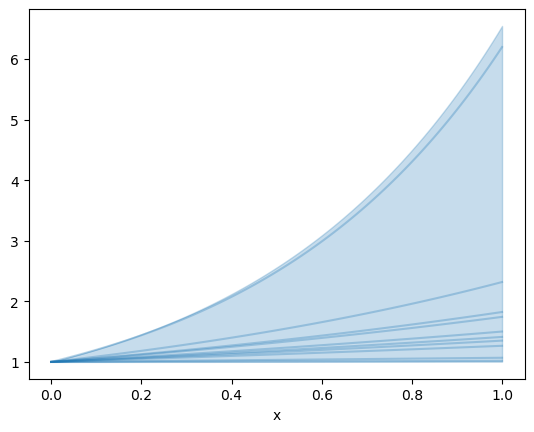
Applying the saturation inside a model now uses core_dim instead of the deprecated dims parameter. For elementwise saturations, core_dim has no effect but is still passed by the framework:
coords = {
    "channel": ["TV", "Radio", "Digital"],
    "date": range(10),
}

x = DataArray(
    np.random.default_rng(0).normal(size=(10, 3)),
    dims=("date", "channel"),
)

with pm.Model(coords=coords):
    result = saturation.apply(x, core_dim="date")

    print(f"Result type: {type(result).__name__}")
    print(f"Result dims: {result.dims}")
Result type: XTensorVariable
Result dims: ('date', 'channel')
Custom Adstock Transformations#
Adstock functions operate along a time dimension (convolution). The key change: instead of assuming a numerical axis (defaulting to 0), the function receives dim by name and must forward it to the underlying convolution function. There’s no default:
from pymc_marketing.mmm import AdstockTransformation
from pymc_marketing.mmm.transformers import geometric_adstock


class MyAdstock(AdstockTransformation):
    """Reinventing the wheel."""

    lookup_name = "my_adstock"

    def function(self, x, alpha, *, dim: str):
        """It's just geometric_adstock."""
        return geometric_adstock(
            x,
            alpha=alpha,
            l_max=self.l_max,
            normalize=self.normalize,
            mode=self.mode,
            dim=dim,
        )

    default_priors = {"alpha": Prior("Beta", alpha=1, beta=3)}


# Sampling and plotting still works the same
rng = np.random.default_rng(0)
adstock = MyAdstock(l_max=10)
prior = adstock.sample_prior(random_seed=rng)
curve = adstock.sample_curve(prior)
adstock.plot_curve(curve, random_seed=rng);
Sampling: [adstock_alpha]
Sampling: []
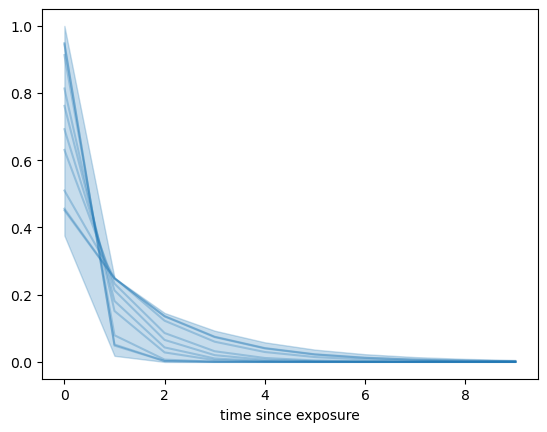
When applying adstock inside a model, core_dim tells the convolution which dimension to operate along:
with pm.Model(coords=coords):
    result = adstock.apply(x, core_dim="date")

    print(f"Result type: {type(result).__name__}")
    print(f"Result dims: {result.dims}")
Result type: XTensorVariable
Result dims: ('channel', 'date')
Custom Model Building with pymc.dims and xtensor#
If you build custom PyMC models that extend MMM, the key changes are:
Use
pymc.dims(pmd) instead ofpymc(pm) for dimension-aware distributions and dataUse
pytensor.xtensor(ptx) instead ofpytensor.tensor(pt) for math operationsWrap raw data with
as_xtensor(data, dims=(...))to give it named dimensions
coords = {
    "date": range(52),
    "channel": ["TV", "Radio"],
}

with pm.Model(coords=coords):
    # pmd creates XTensorVariables with named dims
    channel_data = pmd.Data(
        "channel_data",
        np.random.default_rng(0).normal(size=(52, 2)),
        dims=("date", "channel"),
    )
    intercept = pmd.Normal("intercept", mu=0, sigma=1)
    beta = pmd.HalfNormal("beta", sigma=1, dims="channel")

    # xtensor math - operations are dimension-aware, no axis= needed
    contribution = beta * channel_data
    total = intercept + contribution.sum(dim="channel")

    # Replace NaNs using xtensor math
    total_clean = ptx.math.switch(ptx.math.isnan(total), 0.0, total)

    mu = pmd.Deterministic("mu", total_clean, dims="date")

    print(f"mu dims: {mu.dims}")
    print(f"beta dims: {beta.dims}")
    print(f"contribution dims: {contribution.dims}")
mu dims: ('date',)
beta dims: ('channel',)
contribution dims: ('channel', 'date')
Quick API Reference#
Old |
New |
|---|---|
|
|
|
|
|
|
|
|
|
|
|
|
|
|
|
|
|
|
|
|
|
|
|
|
Further Reading#
pymc.dimsdocumentation — dimension-aware model building in PyMCxtensordocumentation — PyTensor’s named-dimension tensor operations
%load_ext watermark
%watermark -n -u -v -iv -w -p pymc_marketing
Last updated: Fri Mar 13 2026

Python implementation: CPython
Python version       : 3.12.8
IPython version      : 8.31.0

pymc_marketing: 0.18.2

pymc_extras   : 0.9.3
pandas        : 2.2.3
pytensor      : 2.38.2
pymc          : 5.28.2
numpy         : 2.2.6
pymc_marketing: 0.18.2
xarray        : 2026.2.0

Watermark: 2.5.0