

LinearTrend#
- pydantic model pymc_marketing.mmm.linear_trend.LinearTrend[source]#
LinearTrend class.
Linear trend component using change points. The trend is defined as:
\[f(t) = k + \sum_{m=0}^{M-1} \delta_m I(t > s_m)\]where:
\(t \ge 0\),
\(k\) is the base intercept,
\(\delta_m\) is the change in the trend at change point \(m\),
\(I\) is the indicator function,
\(s_m\) is the change point.
The change points are defined as:
\[s_m = \frac{m}{M-1} T, 0 \le m \le M-1\]where \(M\) is the number of change points (\(M>1\)) and \(T\) is the time of the last observed data point.
The priors for the trend parameters are:
\(k \sim \text{Normal}(0, 0.05)\)
\(\delta_m \sim \text{Laplace}(0, 0.25)\)
- Parameters:
- priors
dict[str,Prior], optional Dictionary with the priors for the trend parameters. The dictionary must have ‘delta’ key. If
include_interceptis True, the ‘k’ key is also required. By default None, or the default priors.- dims
Dims, optional Dimensions of the parameters, by default None or empty.
- n_changepoints
int, optional Number of changepoints, by default 10.
- include_interceptbool, optional
Include an intercept in the trend, by default False
- priors
References
- Adapted from MBrouns/timeseers package:
Examples
Linear trend with 10 changepoints:
from pymc_marketing.mmm import LinearTrend

trend = LinearTrend(n_changepoints=10)
Use the trend in a model:
import pymc as pm
import numpy as np

import pandas as pd

n_years = 3
n_dates = 52 * n_years
first_date = "2020-01-01"
dates = pd.date_range(first_date, periods=n_dates, freq="W-MON")
dayofyear = dates.dayofyear.to_numpy()
t = (dates - dates[0]).days.to_numpy()
t = t / 365.25

coords = {"date": dates}
with pm.Model(coords=coords) as model:
    intercept = pm.Normal("intercept", mu=0, sigma=1)
    mu = intercept + trend.apply(t)

    sigma = pm.Gamma("sigma", mu=0.1, sigma=0.025)

    pm.Normal("obs", mu=mu, sigma=sigma, dims="date")
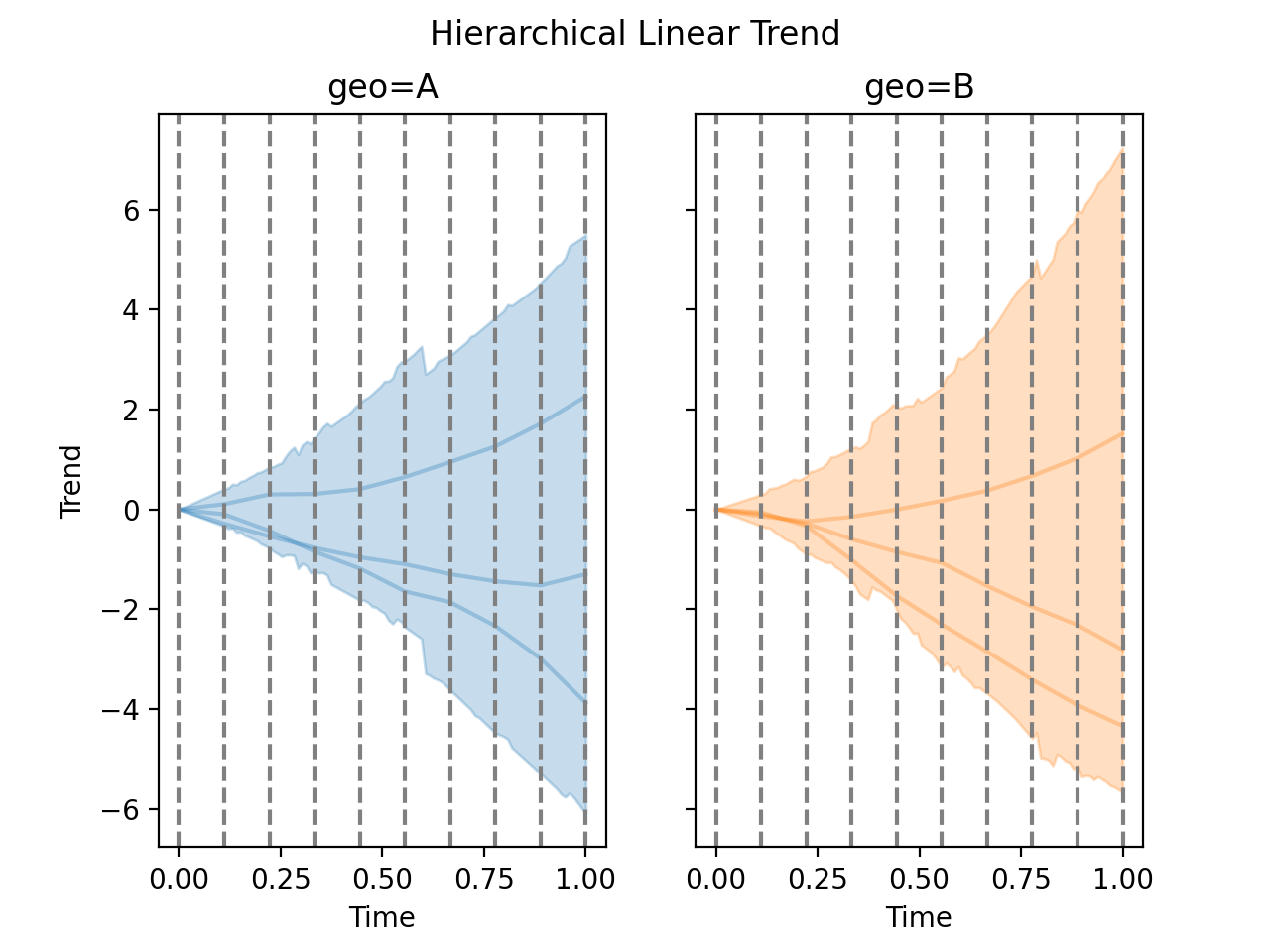
Hierarchical LinearTrend via hierarchical prior:
from pymc_extras.prior import Prior

hierarchical_delta = Prior(
    "Laplace",
    mu=Prior("Normal", dims="changepoint"),
    b=Prior("HalfNormal", dims="changepoint"),
    dims=("changepoint", "geo"),
)
priors = dict(delta=hierarchical_delta)

hierarchical_trend = LinearTrend(
    priors=priors,
    n_changepoints=10,
    dims="geo",
)
Sample the hierarchical trend:
seed = sum(map(ord, "Hierarchical LinearTrend"))
rng = np.random.default_rng(seed)

coords = {"geo": ["A", "B"]}
prior = hierarchical_trend.sample_prior(
    coords=coords,
    random_seed=rng,
)
curve = hierarchical_trend.sample_curve(prior)
Plot the curve HDI and samples:
fig, axes = hierarchical_trend.plot_curve(
    curve,
    n_samples=3,
    random_seed=rng,
)
fig.suptitle("Hierarchical Linear Trend")
axes[0].set(ylabel="Trend", xlabel="Time")
axes[1].set(xlabel="Time")
Methods
LinearTrend.__init__(**data)Create a new model by parsing and validating input data from keyword arguments.
Create the linear trend for the given x values.
LinearTrend.from_dict(data)Reconstruct from a dict.
LinearTrend.plot_curve(curve[, n_samples, ...])Plot the curve samples from the trend.
LinearTrend.sample_curve(parameters[, max_value])Sample the curve given parameters.
LinearTrend.sample_prior([coords])Sample the prior for the parameters used in the trend.
LinearTrend.to_dict([_orig])